
Defence Technology
Electronic Warfare Laboratory
About Product
SkySim offers flexibility in simulating various radar types and deploying diverse scenarios and use cases. It is particularly advantageous for distance learning programs. Like our live radars, SkySim generates IQ signals that can be visualized and manipulated within FreeScopes, enhancing the learning and operational experience. This first package of electronic counter-countermeasures supports detecting various forms of jamming and range deception jamming. It can work in conjunction with the NextGen 8 GHz Pulse radar or the simulator SkySim.
The simulator is based on a simulated radar model with parameters like detection probability, false alarm rate, range, and range resolution, and for the targets: Target RCS
Modulation & Waveform: Rectangular pulses (variable), PRF (variable) ,Pulse width (variable)
Noise: Receiver side --> thermal noise on the receiver. Clutter, Artificial Jamming (Noise, Active Target, Deception Jamming).
Transmitter: Stimulated emission power is based on the required signal-to-noise ratio (SNR). SNR is a function of Pd, Pfa, and pulse integration, Ptx (minimum value) calculated from the radar equation.
Antennas: Radiator Tx for Radar and Jammer, Collector Rx for Radar and Jammer, Sending Lobes and Side lobes like a real radar.
Simulation: Static and moving targets in the simulation environment, Spectrogram of simulated waveforms, and Spectrogram can be used for Jamming detection
Propagation Environment: Propagation channel between radar and target: Sampling Rate, Wave Propagation, Operating frequency.
Simulator Output: The simulator provides JSON-formatted I&Q data as output. It is enhanced with metadata like time stamps. It can be directly used in FreeScopes or passed to analytic environments like MATLAB with SkyRadar's SDK.
Signal Processing: Signal Processing is done in FreeScopes, based on IQ Data, Power Detection
Jamming: The jammers in the simulated jamming environment are able to match the following radar characteristics: operating frequency, pulse repetition frequency (PRF), pulse repetition interval (PRI), and pulse width.
The simulator for Jammers makes use of the Radar Model. It can emulate noise jammers and deception jammers.
Noise Jammers: Barrage jamming, spot jamming.
Deception Jammers: Repeater jamming, Range deception jamming
Different Scopes: A-Scope, B-Scope, and PPI
The Control Centre reads out I and Q data from the Pulse Radar.
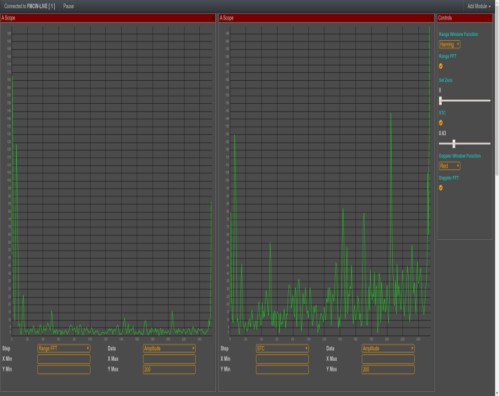
It embeds several filters, i.e., TxPower Control, FFT, Threshold limiter, STC, and Contrast.
Allowing manipulations of the signals.
The module also provides a set of features, including MTI (Moving Target Indication), C-FAR, RCS, Windows Functions (Hann, Hamming, Blackman, and more), Spectrogram, 3D Scope, Heat Map, Radar Plots, Radar Tracks, MTD, MTD with Doppler Filter, MTI with Post-Processing, Standing Person Algorithm, Doppler Filter, iMM (Interactive Multiple Model), Kalman Filter, and Zero Velocity Filter. Clutter Map Subtraction, Signal Delay Block
NextGen FreeScopes ATC Disturbance Filtering and Analysis, IFreeScopes Software Extension, expanding NextGen FreeScopes ATC I
The module provides a set of prediction-based features including:
Kalman filter (filtering out non-predictive values), Cluttermap comparison, MTI-based analysis, Doppler Phase Shift.
Master Controller PC with Display Wall
Validate the range resolution of the radar.
The Radar Equation:
Experiment: Showing the dependence of the transmitter power and the amplitude.
Experiment: Showing the dependence of the target’s distance (range) and the amplitude
Experiment: Showing the dependence of the antenna gain and the amplitude (only for radars with reflectors)Applying Sensitivity TimeControl (STC)
Familiarize with the A-scope and PPI-scope.
Moving Target Indication MTI: Eliminate static targets in the A-Scope andPPI
Understanding the Relationship of Movements and IQ signals
Measure the beam antenna half-power beam width
Radar Cross Section:
Experiment: Showing the dependence of target size and the amplitude
Experiment: Showing the dependence of target angle and the amplitude
Experiment: Showing the dependence of the target shape and the amplitude
Experiment: Showing the dependence of target material and the amplitudeFFT and the Doppler Effect, FFT of Measured Signal.
Experiment on CFAR 2D and FFT 2D.
Understanding Heatmap and Doppler.
Compare performance of MTI with MTI Post Process
Understanding Moving Target detection (MTD) & MTD with Doppler Filter (MTD DF)
Compare the performance of MTI, MTI PP, MTD, and MTD DF
Standing Person Recognition Algorithm.
Understanding Plots and Tracks
Kalman filter
Signal Detection
Phase Shift Detection
Association (ASO)
Kalman Filter Block DiagramZero Velocity filter
With 35 years of legacy in Technical Education, Akademika extends its expertise to Defence and Skill development, building Innovative, Reliable Training Systems for the next generation of Learners.
Partner with Akademika
Join leading institutions that trust our engineering to Advance Learning and Research.