
Defence Technology
EMI and EMC Pre-Compliance Set up and Training kit
About Product
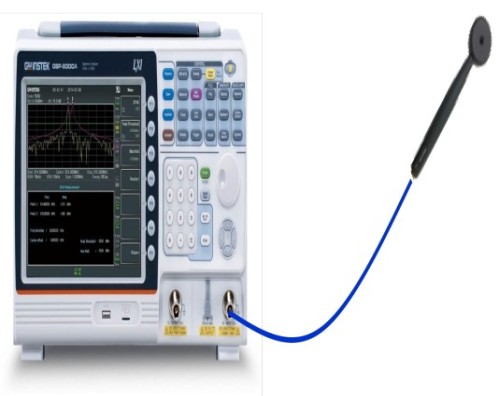
This EMI–EMC Pre-Compliance & Training System combines a 3.25 GHz spectrum analyzer, LISN, isolation transformer, transient limiter, and EMI probe kit to perform complete conducted and radiated EMI diagnostics. It also includes RF and microstrip training modules for hands-on learning of high-frequency circuits, filters, matching, and active RF components.
The system offers complete EMI–EMC pre-compliance capability with built-in CISPR standards, peak/QP/average detectors, and automated PASS/FAIL analysis.
It includes near-field probes for pinpointing PCB-level EMI sources and a full conducted EMI chain with LISN, isolation transformer, and transient limiter.
The analyzer provides far-field estimation, advanced visualization modes, and PC software for reporting.
Additionally, RF and microstrip training modules enable practical learning of filters, transmission lines, matching networks, resonators, and active RF circuits.
This makes it a comprehensive solution for testing, troubleshooting, and education in high-frequency and EMC domains.
A 9 kHz–3.25 GHz EMC-ready analyzer with built-in CISPR filters, peak/QP/average detectors, preamp, fast sweep, and automated PASS/FAIL EMI testing.
A 4-probe set (magnetic, electric, RF contact, AC voltage) designed for high-sensitivity PCB EMI hotspot detection with no angle/directivity issues.
CISPR 16-1-2 compliant LISN for conducted EMI testing from 9 kHz–30 MHz, providing a stable reference path and mains noise filtering.
Protects the analyzer input from high-voltage spikes during conducted EMI and AC probe measurements.
Ensures safe conducted EMI testing by isolating DUT from mains, eliminating leakage currents and preventing test bench trips.
Hands-on RF board featuring transmission lines, discontinuities, matching networks, resonators, and active RF components such as LNAs, PLLs, and oscillators.
A microstrip board with filters, couplers, attenuators, power dividers, resonators, mixers, VCOs, and microwave networks for practical RF-microwave experimentation.
Measure ambient RF noise and compare it with DUT emissions using near-field probes.
Use ANT-04/05 probes to locate PCB, IC, cable, or SMPS points generating high EMI.
Perform mains-line EMI testing using LISN + transient limiter to view peak/QP/avg noise.
Analyze how different EMI detectors affect measured levels and compliance results.
Observe how radiation increases with longer cables and decreases with shorter ones.
Verify noise reduction using capacitors, inductors, ferrite beads, and LC filters.
Measure EMI before and after applying copper tape/EMI gasket/absorber material.
Convert near-field probe readings into predicted chamber results using analyzer’s EMI mode.
Examine losses, impedance, and frequency response of microstrip, CPW, slotline, etc.
Test how gaps, bends, tees, and steps affect signal reflection and attenuation.
Measure frequency response and cutoff behaviour of various RF filters.
Study stub matching, L/π/T networks, and quarter-wave transformers for impedance matching.
Analyze amplifiers, oscillators, PLLs, multipliers, and VCOs for gain, frequency, and noise.
Experiment with coupling ratios, insertion loss, isolation, and power splitting.
Use AC voltage probe to directly measure SMPS and mains-borne EMI noise.
Inspect ground loops, clock lines, I/O pins, and DC traces for localized EMI emission.
With 35 years of legacy in Technical Education, Akademika extends its expertise to Defence and Skill development, building Innovative, Reliable Training Systems for the next generation of Learners.
Partner with Akademika
Join leading institutions that trust our engineering to Advance Learning and Research.