
Technology Labs
SONAR
About Product
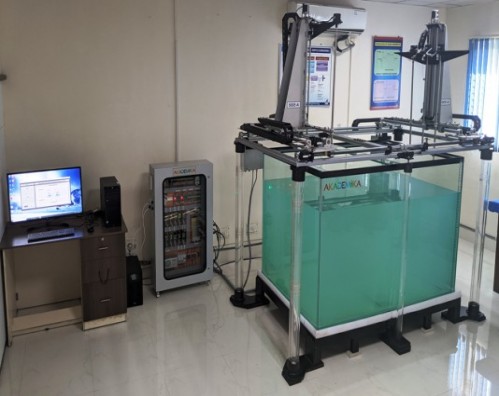
The Akademika ASDEP is a lab-based underwater research platform featuring a large water tank, a 12-axis automated motion gantry, and NI-based control electronics. It enables SONAR testing, underwater acoustics, and sensor characterization with precise X-Y-Z motion, 360° rotation, and LabVIEW-controlled operation.
Akademika has designed an Electromechanical Platform for the Professor and Students to carry out Under-water Research activity at the comfort of Laboratory environment
Be it underwater communication or testing of various transducers/ sensors our Acoustic System Development and Experimental Platform is a perfect platform for you to carry out your research activities
Electro-mechanical system having automated 12-axis of motion support and 4 degrees of freedom.
Includes a water tank to carry out underwater experimentation in lab environment.
Mechanical gantry made up of aluminum extrusion profiles supporting the transport system & transducer guide rail.
Structure placed over a 15 mm soft glass tank (6’ × 4’ × 4’) with separate ground support.
Provision to hold six external sensors/transducers.
Custom-designed sensor couplers based on user sensor dimensions.
All external sensors have X, Y, Z motion as a group, and each can rotate 360° about its own axis.
A dedicated control panel provides an interface between the gantry & LabVIEW-based motion control software.
Glass Water Tank with Rigid MS Base
Soft glass with 15 mm wall thickness.
Dimensions: 6’ × 4’ × 4’, open from top.
Designed to withstand 2,000 kg of water.
Scale provided for water level indication.
Maximum recommended level: 3 feet.
Heater rod installation provision available.
Rigid lightweight metal platform to hold tank.
Cushion provided to avoid metal–glass contact & absorb vibrations.
Anti-vibration pads used under base legs.
Mechanical Gantry
Frame: Extruded Aluminium
Lead screw mechanism, pitch: 2 mm
Axis Motion Ranges:
– X-Axis : max traverse 610 mm.
– Y-Axis : max. 430 mm, min. 280 mm.
– Z-Axis : max traverse 650 mm.Rotational Axis: 360°
Sensor Holder
Material: Delrin
Holding capacity: 1 kg
Holder length: 2.5’, telescopic +1.5’, max span: 4’
Motors
Side A & Side B:
6 Stepper Motors each for X-Y-Z motions
6 Motors for rotational motion (R1, R2, R3, R4, R5, R6)
X & Y axis: 20 kg stepper motor
Z & Rotational axis: 10 kg stepper motor
Electrical Control Panel
2 × NI 24-channel Digital I/O cards
2 × PLCs
7 × Opto-isolator cards
12 × Stepper motor drives
SMPS-1: 24V DC, 2.5A
SMPS-2: 24V DC, 20A
SMPS-3: 36V DC, 16A
3 × MCB
Software
Motion Control Software (EXE) based on LabVIEW.
Provided as Test/Demo program for axis motion.
Custom advanced software available as optional upgrade.
DELIVERABLES
6’ × 4’ × 4’ Water Tank mounted on Rigid MS Base – 1 No
Mechanical Gantry with 12 AXIS of Motion – 1 Set
Control Panel – 1 No
Akademika Motion Control Software (Test/Demo Version) – 1 No
2W Heaters – 1 No.
½ HP Water Pump – 1 No
Inlet Pipe – 12 feet
Outlet Pipe – 100 feet
Set of Manuals – 1 No
CUSTOMERS
INS Valsura (Ministry of Defence)
Indian Naval Academy (Ministry of Defence)
Akademika developed an advanced electromechanical underwater research platform to allow professors and students to perform underwater experiments directly inside the laboratory.
The experiment involved using this platform to study underwater communication and to test different acoustic transducers and sensors inside a controlled water tank environment.
Using the automated 12-axis gantry, the team positioned and moved sensors precisely in X-Y-Z directions and rotated them 360° to capture underwater acoustic responses.
The system’s integrated LabVIEW motion control software was used to automate sensor movement, triggering measurements, and observing underwater signal behavior.
Under-water communication experiments.
Testing of different sensors under water.
Motion-controlled underwater measurements using 12-axis gantry.
Under-water acoustic research in controlled lab environment.
This experiment demonstrated how the platform can replicate realistic underwater conditions, enabling research on signal propagation, sensor performance, and acoustic communication techniques without needing open-water testing.
With 35 years of legacy in Technical Education, Akademika extends its expertise to Defence and Skill development, building Innovative, Reliable Training Systems for the next generation of Learners.
Partner with Akademika
Join leading institutions that trust our engineering to Advance Learning and Research.