
Skill Development
Drone Technician
About Product
The Directorate General of Training (DGT) under the Ministry of Skill Development & Entrepreneurship offers the vocational training programs delivered under the Craftsman Training Scheme (CTS) and Apprenticeship Training Scheme (ATS), two pioneer programs for vocational training. The Drone Technician course under CTS is one of the newly designed courses delivered nationwide through a network of training institutes.
ABOUT THE LABORATORY
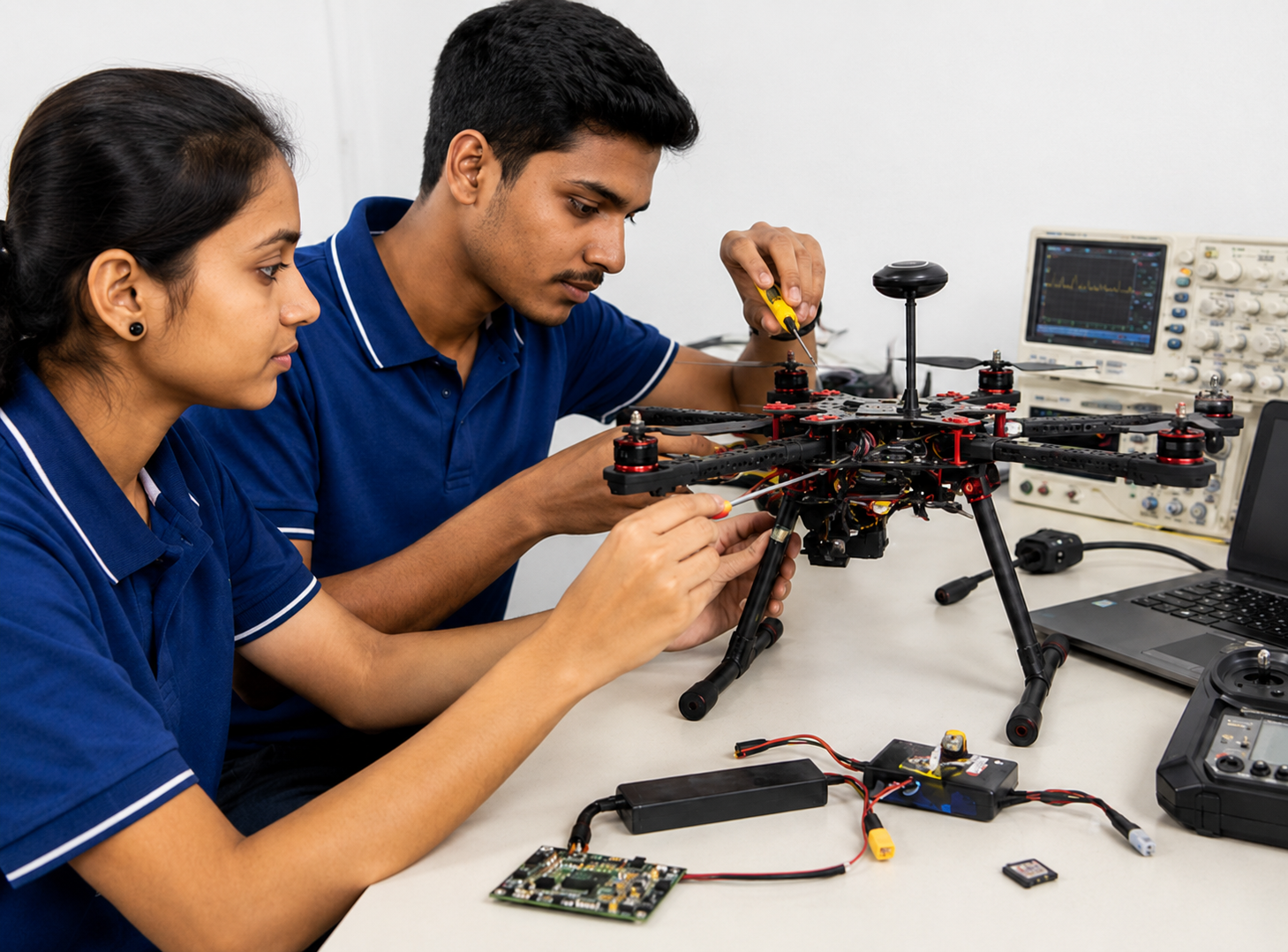
The Drone Technology Laboratory for Skill Development and Universities is a specialized facility designed by AKADEMIKA to provide hands-on training and practical experience in the field of drone technology. It serves as a dedicated space where individuals can develop the necessary skills and competencies to effectively operate, maintain, and utilize drones across various industries.
KEY FEATURES OF THE DRONE TECHNOLOGY LABORATORY:
State-of-the-art Equipment: The laboratory is equipped with cutting-edge drones, flight simulators, data acquisition tools, and software applications to provide a realistic learning environment. Students have access to a wide range of drone models, ensuring exposure to different configurations and capabilities.
Training Modules: The laboratory offers a comprehensive curriculum that covers the fundamental concepts of drones, flight operations, data analysis, and industry-specific applications
Practical Hands-on Experience: The laboratory emphasizes practical learning through hands-on exercises and simulations. Participants have the opportunity to practice drone flight operations, capture aerial media, process data, and troubleshoot technical issues.
Safety Protocols and Best Practices: Safety is a paramount concern in drone operations. The laboratory promotes the implementation of safety protocols, including pre-flight checks, airspace regulations, emergency procedures, and risk management strategies. Participants learn the importance of responsible drone use and the ethical considerations associated with drone technology.
Opportunities: Upon successful completion of the Training program, Students will enhance their employability Skills and open doors to various career opportunities in sectors such as agriculture, construction, film production, surveying, and more.
The Drone Technology Laboratory aims to bridge the gap between theoretical knowledge and practical application, equipping individuals with the expertise needed to thrive in the rapidly growing field of drone technology
WORKBENCH FOR CHARACTERIZATION OF DRONES COMPONENTS
MODEL DT-TMS: THRUST MEASUREMENT SYSTEM ( MOTORS & PROPELLER )
This system has the facility to characterize and evaluate the performance of BLDC motors and propellers by measuring thrust, torque, RPM, current, voltage, temperature, propeller efficiency, and motor efficiency.
SPECIFICATIONS :
Measuring the Thrust Range -5 to 5 Kgf with resolution of 0.05 Kgf and Torque Range (-2to 2 Nm ) of the Motors
Measuring the Electrical Current (0 to 55 A) and Voltage (0 to 50 V)
Measure the motor's angular rotation speed upto 190K eRPM. Coil Resistance: 0.003 - 240 OhmsThe Software is capable to control the system manually and view live data as it is recorded.
It has in- built features:
Control the entire system from a Python API is provided.
Upload the .CSV files from the flight controller to perform flight replay tests
Plot real-time graphs, manual motor control, and manual servo control.
Automated Tests like Ramps, Steps, Measure (kV), measure of the number of poles, etc.Accessories:
Optical RPM Probe, No-Solder Board, 5 Propellers of different sizes (7.0”x 4.0”), (8.0 x 4.0), (8.0; x 6.0), (8.0 x 8.0), and (9.0 x 4.0).
2 motors with ratings at 1500 Kv and 2300 Kv, respectively, and a motor controller ESCMODEL DT-DBMTS : DRONE BATTERY MANAGEMENT TRAINING SYSTEM
The Battery Management Training System has the features to monitor Cell Balancing, Changing and Discharging of Batteries, Endurance Testing of Drone with Specific LiPo Battery and motor combinations, and Calculation of C Rating for an LiPo battery.
Battery Capacity: 7000 mAh and 16000 mAh, 6 S, 24 V
High Precision Wattmeter and Power Analyzer, which has the facility to measure 8 critical parameters to serve as a key to electric power safety & performance.
Servo Driver/Tester: To control the speed of the Motor
ESC: Constant Current (A): 80, BEC: Yes (5V/5A)
BLDC Motor: Speed: 36000 RPM +/- 10%, Propeller Diameter: 10”, Pitch: 4.5 “
BLDC Motor and Propeller System mounted on a stand acting as a load to the Battery Management system.
Setup is provided with the work table.
MODEL DT-MICRO-U: ASSEMBLY, PROGRAMMING AND CONFIGURATION OF UN-ASSEMBLED DRONE KIT
TECHNICAL SPECIFICATIONS
The Unassembled Micro Drone Quad Copter Training System has the Following Features:
Arm® Cortex®-M7 processor: STM32H753IIK6 and coprocessor STM32F103 with Floating Point Unit (FPU), 480 MHz high-speed operations, and 2 MB flash.
Facility for more complex algorithms and models.
TELEMETRY Ports with full flow control, 4 power input ports—2 for Drone CAN power inputs and 2 for SMBUS/I2C power inputs,
An independent LDO powers every sensor set with independent power control.
Vibration isolation system to filter out high-frequency vibration and reduce noise to ensure accurate readings, allowing vehicles to reach better overall flight performances. 1 UART4 (Serial and I2C)
Lidar sensor for distance measurement.
2.4 GHz remote module System, frequency hopping and Low Power Consumption with Throttle curves, Pitch curves, endpoint adjustments, and Servo reversingUn-Assembled Quad copter kit includes
GPS Module: Concurrent GNSS: up to 10 Hz.
Adv GPS Module: The GNSS U-BLOX M9N CAN BUS is a new product from the CUAV brand. NEO 3 Pro continues the hardware design of NEO V2, upgrade the GNSS module to Ublox NEO M9N, supports Beidou, Galileo, Glonas, and GPS receive the same time, and the horizontal positioning accuracy is up to 0.7m. Integrated with safety swith, buzzer, RGB light.
Propellers: Length: 10”, 10”,Pitch: 4.5”
Frame: Wheel Base 450mm, Material Glass Fiber + Polymide Nylon, Motor Mounting Hole Dia.: 3 mm, Arm Size: 220 x 40 mm.
Landing Gear: Compatible to the Frame specification.
BLDC Motors: Brushless 920 RPM Voltage: 7.2v~11.1v / 2s~3s Lipo, Shaft Length: 10mm or more, Max Watts: 260W, Minimum 900 KV or more, Screw Size:
M3.
Electronic Speed controllers: Brushless ESC 30A up to 2-4S Brushless ESC,BEC output : 5V 2A.
FCB (Flight Controller Board): Up to 14 PWM / servo output, Bus interface (UART, I2C, SPI);provide redundant power input, Multicolor LED lights, Provide a multi-tone buzzer interface/motor winding tone.
FCB (Flight Controller Board): Up to 16 PWM / servo output, Triple redundant IMU & double redundant barometer on separate buses, Integrated Microchip Ethernet PHY for high speed communication, dual processor, 2x I2C ports for external compass, airspeed sensor, etc. on GPSconnector, PPM/SBUS input, DSM/SBUS input, 2 x CAN port, 8x UARTS 6 Available for customer use, Dual SMBUS/I2C Power Module Inputs.
FPV Camera (Sensor): Image Sensor: CCD, Power: DC 5-36V, Operating Current: 5V@60 mA, Horizontal Resolution: 600 TVL.
FPV Live video transmitting goggles—Receiver: Varifocal 5.8G 40CH Diversity FPV Goggles, Varifocal lenses for adjustable focus, catering to individual eyesight needs 5.8 Ghz frequency with 40 channels for stable and interference-free FPV transmission, Diversity feature for enhanced signalreception, reducing signal loss and improving image quality. Built-in DVR (Digital Video Recorder) forrecording flight footage directly onto a micro SD card, Large 5-inch HD LCD screen for immersive FPV experience
Camera Transmitter : Channels: up to 40 CH,Frequency: 5.6GHz-5.9GHz,Antenna: RP-SMA Male.
RF Transmitter and receiver: 10 channels, 2.40 - 2.48GHz frequency ,Power ; 12V,Battery 8 AA;
Telemetry: 915 MHz, Mavlink Protocol, Receiver Sensitivity: -121 dBm , Transmit Power up to 20 dBm
Lidar: Operating Range: 0.2m~8m (90% reflectivity), Accuracy: ±6 cm @ (0.2 m-3 ±6 cm @ (0.2 m-3 m), ±2% @ (3 m-8 m), Distance resolution (cm): 1
Gimbal: 2-Axis Brushless Gimbals, Carbon Fiber Material, Motor drivers, Onboard MPU.
HD Camera/Action Camera: 3840 X 2160 Resolution, 4K 30 fps, SD Card Support, 90 min run time, SONY 8 MP sensor lens.MODEL DT-SDS 661 DEVELOPMENT KIT
Control unit with integrated gyro sensor and Ethernet UDP data communication.
Supplied with an Embedded Computer Quad Core Cortex-A72 (ARM v8) 64-bit SoC, 2.4 GHz and 5.0.
GHz IEEE 802.11ac wireless, Bluetooth 5.0, BLE, Gigabit Ethernet, 2 USB 3.0 ports, 2 USB 2.0 ports, 2 × micro-HDMI® ports (up to 4kp60 supported).
Sensor board incorporating four toroidal optic sensor modules with an infrared-optimized housing and carbon fiber mounting plate.
The software package includes algorithms, host processing SDK, demonstration software, and visualization tools. Set of IR sensors and controller board for indoor environment testing.
SENSOR MODULE: The sensor unit has the facility to be installed on the drone in a position providing a field of view to landing beacons on the ground.
BEACON INSTALLATION: The beacons are possible to be installed on the ground or a moving target, aimed upward. For a full 6d of tracking, the beacons include one high-powered beacon and 4 lower-powered beacons. Each beacon has a unique code.
FIELD OF VIEW: The sensor has a 120-degree field of view. Line of sight between sensor and beacon is required.
RANGE: up to 30 m in full sunlight.
ALGORITHM SOFTWARE: Lightweight, capable of running on a embedded computer
HIGH SPEED Tracking speeds up to 400 Hz
HARDWARE INTERFACE: UDP RJ45 connection between sensor board and embedded computer.
SOFTWARE INTERFACE SDK and API should be available for data interface.Performance Parameter
Absolute Angular Accuracy <0.2 over 120 Degree FoV
Absolute Positional Accuracy: As low as <1cm
Repeatability: 2 < 0.5 cm lateral, < 0.1 Degree rotational
Sensitivity: 3 < 0.2 cm lateral, < 0.05 Degree rotational
Field-of-view 120 Degree x 120 Degree
Operating light levels: 10 – 100,000 lux
Interface Ethernet (UDP)
Power supply from USB host (5V 200 mA = 1 W)
Raw measurement frequency Over 10,000 FPS Capture latency <2msPower Distribution Board with Power Module – 10 Nos
Mission Planning Software for Configuration and Calibration of the Drone
Facility to interface the GCS over a Smartphone or Computer Accessories: Lipo Battery – 20
Nos and Charger -10 Nos,
USB Cable – 5 Nos, Lipo Checker- 10 Nos
WORKBENCH FOR PROGRAMMABLE NANO DRONE
SPECIFICATION
Programmable: C++-based API structure making it extremely easy to program.
HD Camera: HD videos and photos – Capability to do ROS based image processing
Drone weight: 65 grams.
Built-in Camera
Material: Nylon
QAV250mm carbon fiber frame 5” propellers
Battery: Lithium Polymer, 150 LiPo quick charge,
Charging time: 30–40 minutes approx. for a full charge, 2 lithium polymer batteries (included).
Modular Hardware
12 GPIO pins to add external hardware
2 DAC channels
Accessible to UART, I2C, SPI, ADC
4 extra reversible motor drivers
3V and 5V output power for hardwarePayload: 15 gram
Range: 50 - 70 m
Flight Time: 7+ Min
Speed: up to 7 m/sec
Two high-speed motors for more thrust, extra maneuverability and sharper turns.
Microcontroller: STM32F303, 256k
Camera: Photo, Video @ 720p
Motor Driver: 4 MOSFET (unidirectional) & 4 H-Bridge drives (Bidirectional)
Propulsion: Brushed coreless DC motors
Gyro accelerometer to prevent nosedives and reduce choppiness.
Accessories: All accessories are provided with the kit for its full feature functioning
Setup is provided with a work table as per the below specifications:
Working bench of dimension (LxWxH ): 4 x 2.5 x 3 (ft.) approx..
A base structure made with 38X38X1.5 mm CRC Epoxy coated pipes and top made of 19mm thick plywood with edge bidding.
MS drawers with 03 numbers with handle & lock on drawer.
Two Pole MCB (16A Good quality ISI mark) to be provided for safety of work table.
Workbench is provided with Anti-static mat, castor wheel and multiple sockets/ Switches for external use
CURRICULAM
Videos & Online Tutorials For DGCA drone rules and regulations / UTM / DIGISKY / Remote Pilot Licensing / Component & Data, Identify & select different types of drones, drone applications, and important safety precautions.
Characterization of Different Drone Parts using Various Test Equipment and Software.
BLDC MOTORS/ESC/PROPELLERS: Identify, select, and test the hardware assembly of the propulsion system, the driver for BLDC motors (ESC), and the compatible propeller.
FLIGHT CONTROL BOARD: Test and troubleshoot Flight Controller Board (FCB), Electronic Speed Controller (ESC) and its associated peripherals.
BATTERIES USED IN DRONES: Identification of different type of batteries, battery specifications and their charging techniques used in drone.
SENSORS: Inspect, test and execute various IMU,GPS navigation and telemetry module, different RF blocks and antennas used in RF transmitter and receiver.
Assembly of various drone parts, Calibration and programming, troubleshooting of a Unassembled Drone.
Introduction to Flight Simulator , Control Checks, Pre Flight Check and Simulator Exercises to have an Hands – on experience before actual flight.
Introduction to autonomous flight systems, Programming and configuring autonomous missions, Sensors and navigation for autonomous drones.
Advanced flight techniques (obstacle avoidance, precision flying).
Drone Data Acquisition and Analysis.
Drone Prototyping: Design frames, propellers, etc., and manufacture using a 3D Printer.
With 35 years of legacy in Technical Education, Akademika extends its expertise to Defence and Skill development, building Innovative, Reliable Training Systems for the next generation of Learners.
Partner with Akademika
Join leading institutions that trust our engineering to Advance Learning and Research.