Technology Labs
PL-DSP : DSP Trainer Kit
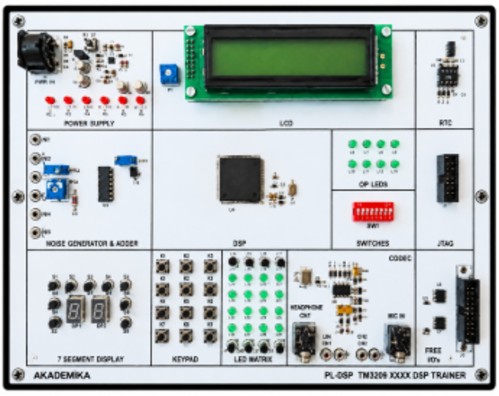
About Product
A versatile digital signal processing training platform powered by the TMS320C6745 DSP, featuring onboard audio interfaces, LCD, keypad, and rich I/O for real-time signal analysis. Ideal for DSP algorithms, audio processing, communication experiments, and image processing fundamentals in advanced electronics labs.
1) This DSP trainer kit uses Texas Instruments
2) TMS320C6745 DSP chip a 375 MHZ device delivering up to 3648 million instructions per second (MIPs) and 2736 MFLOPS
3) This DSP Trainer is specifically designed in a modular and user friendly format with many on board interfaces.
4) On board clock generator
5) White noise generator
6) Signal and noise adder
7) Power : Regulated supply
8) Test points : For important signals and power rails
HARDWARE
1) JTAG supported via USB
2) TLV320AIC23B programmable stereo codec
3) Two 3.5mm audio jacks for microphone and speaker
4) Expansion port for plug-in modules
5) Power supply : +5V, ±12V, GND
6) 8 DIP switches for inputs and 8 LED indication for output
7) Provision for manual Reset
8) On board 4x4 LED matrix
9) On board White noise source of amplitude 0 – 5Vpp
10) On board 20x2 character LCD display
11) On board 7 segment displays
12) On board RTC interface : I2C based RTC section
13) On board Phone keypad : 0 to 9 digits and *, # characters
14) Code composer studio for the TMS320C6745 is included
SOFTWARE
Code Composer Studio (CCS) : Code Composer Studio (CCS) is an integrated development environment (IDE) created by Texas Instruments (TI) to help write, build, and debug programs for their digital signal processors (DSPs), microcontrollers, and embedded processors
1) To study the architecture of DSP chips – TMS 320c6X instructions
2) To verify linear and circular convolution
3) To design FIR(LP/HP/BP) filters using windowing technique
a) using rectangular window
b) using triangular window
c) using kaiser window
4) To implement IIR(HP/LP/BP) using following window
a) Chebyshev filter
b) Butterworth filter
5) N-point FFT algorithm
6) N-point DFT and IDFT of given sequence
7) Frequency response of system which is given in transfer function and differential form
8) Power spectrum density
9) Generation of sine wave
10) DFT and IFFT using DIT and DIF methods
11) Auto-correlation, cross-correlation and it's property
12) Sampling of sine signal
13) Amplitude modulation, frequency modulation and FSK modulation
14) FIR filter using Blackman and hamming window
15) Generation of square wave
16) Implementation of decimation, interpolation and I/D sampling rate converter
17) Impulse response of 1ˢᵗ and 2ⁿᵈ order system
18) Addition and removal of noise
19) Spectrogram of audio or sine signal
20) Generation of DTMF signals and spectrogram of DTMF signal
21) RTC displayed on LCD
22) Signal companding using µ-law
23) Generation of sinusoidal wave based on recursive differential equation
24) Generation of sinusoidal through filtering
25) To find the FFT of given signal
26) FIR filter using Fourier series expansion method
With 35 years of legacy in Technical Education, Akademika extends its expertise to Defence and Skill development, building Innovative, Reliable Training Systems for the next generation of Learners.
Partner with Akademika
Join leading institutions that trust our engineering to Advance Learning and Research.