Technology Labs
SDR-B: Software Defined Radio
About Product
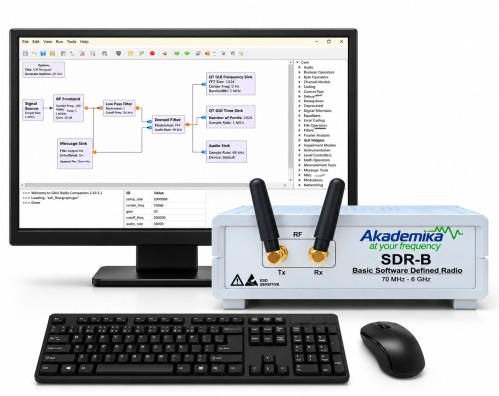
The SDR-B platform introduces students to modern communication systems using real-time hardware and GNU Radio–based software processing, enabling hands-on learning in both analog and digital modulation. With zero-installation capability and an RF agile transceiver up to 6 GHz, it delivers a seamless experience from signal generation to wireless experimentation.
1) Software Define Radio single Input single Output (SISO).
2) Unleash the power of GNU Radio ecosystem.
3) System allows to make telecommunication block diagram and equations comes to life using simple building blocks.
4) Open-ended system for real-time communication experiments.
2) Unleash the power of GNU Radio ecosystem.
3) System allows to make telecommunication block diagram and equations comes to life using simple building blocks.
4) Open-ended system for real-time communication experiments.
1) RF Agile Transceiver
i) One Transmit, One Receive Channel (with separate Tuning Frequencies)
ii) Tuning Range : 70 MHz - 6 GHz
iii) LO step size: 2.4 Hz
iv) Tunable Channel Bandwidth : 200 KHz – 20 MHz
v) Integrated DACs (Tx) : 12-bit
vi) Integrated ADCs (Rx) : 12-bit
vii) Variable Output Data Rates : 61.44 MSPS - 65.1 KSPS
viii) Modulation Accuracy (EVM) : ≤−40 dB (typical)
ix) RX Gain Control : 0 to +74.5dB (800 Mhz)
x) Received Signal Strength : 100 dB (±2 dB)
xi) Internal I/Q Correction and Calibration
2) Antenna
i) Frequency Range : 824-894 MHz and 1710 - 2170MHz
ii) Connector Type : SMA
3) FPGA
i) Logic Cells : 28k
ii) Block RAM : 2.1Mb
iii) DSP Slices : 80
4) SDR Processing System
i) Single-core ARM® Cortex™-A9 MPCore™ @ 667 MHZ
ii) Streams up to 4MSPS with no dropped samples
5) Memory
i) DDR3L
ii) 1066 Mbps (16-bit Interface) , 512 Mbytes
6) Serial Flash
i) 32 Mbyte
ii) Quad I/O provides throughput up to 54 Mbps
7) Required Software Stack
i) Operating System : Linux / Ubuntu
ii) GNU Radio (3.10.x with Python 3)
8) Required Computer Configuration
i) 8 GB RAM, Intel processor
ii) USB : USB 2.0 supported (USB2.0 A to B Cable - M/M)
iii) Display: 14" with Mouse and Keypad provided
Analog Communication
1) Amplitude Modulation & Demodulation
2) Double Side Band with Suppressed Carrier (DSBSC) Modulation & Demodulation
3) Receiver Selectivity using Band pass filter with DSBSC
4) Single Side Band with Suppressed Carrier (SSBSC) Modulation & Demodulation
5) Frequency Modulation & Demodulation
6) Pulse Amplitude Modulation & Demodulation
Digital Communication
1) Sampling and Quantization
2) Amplitude Shift Keying (ASK) Generation & Demodulation
3) Frequency Shift Keying (FSK) Generation & Demodulation
4) Binary Phase Shift Keying (BPSK) Generation & Demodulation
5) Quadrature Phase Shift Keying (QPSK) Generation & Demodulation
6) Differential Phase Shift Keying (DPSK) Generation & Demodulation
7) Digital Quadrature Amplitude (DQAM) Modulation & Demodulation
8) Differential Pulse Code Modulation (DPCM)
9) Frequency Hopping Spread Spectrum (FHSS)
10) Orthogonal Frequency Division Multiplexing (OFDM)
11) Adaptive Modulation based on SNR
With 35 years of legacy in Technical Education, Akademika extends its expertise to Defence and Skill development, building Innovative, Reliable Training Systems for the next generation of Learners.
Partner with Akademika
Join leading institutions that trust our engineering to Advance Learning and Research.