
Technology Labs
VL- SiEN : SiEN FPGA DEVELOPMENT BOARD
About Product
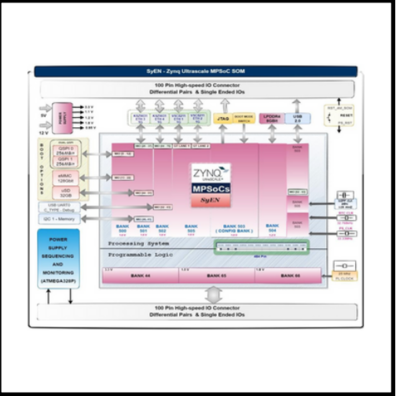
SiEN (Temple) is an industrial-grade, compact SBC based on Xilinx® Zynq™ UltraScale+™ MPSoC (CG/EG Series). It combines ARM® multi-core processing with FPGA fabric, enabling high-performance embedded networking, vision, and real-time control applications. Integrated power management, Linux BSP, and customizable carrier board ensure rapid prototyping and low BOM cost.
Zynq UltraScale+ MPSoC Architecture
Combines multi-core ARM Cortex-A53 processing (CG/EG series) with advanced low-power FPGA fabric for heterogeneous computing
Industrial-Grade Two-Board Design (SoM + Carrier)
Modular architecture enables rapid prototyping, low BOM cost, and easy customization for industrial applications.
High-Performance Memory & Storage Support
Supports up to 8 GB LPDDR4, 32 Gb eMMC, and QSPI flash, suitable for Linux-based embedded systems
Rich Networking Interfaces
Includes 4× Gigabit Ethernet (RJ45 + SFP optical), enabling networking, industrial communication, and edge-compute use cases
Extensive FPGA & Industrial I/O
Provides 170 FPGA I/Os, CAN 2.0, UART, RS-485, isolated digital I/O, analog inputs, and GPIOs
Secure & Embedded-Ready Platform
On-board unique encryption ID, unique MAC ID, Linux BSP support, and multiple boot options (JTAG/QSPI/eMMC).
System on Module Board
Processor:
EG series: Quad-core Arm Cortex-A53 MP Core
CG series: Dual-core Arm Cortex-A53 MP Core
Enhanced NEON Extension and Single & Double Precision FPU.
32KB Instruction and Data L1 Cache
64KB Unified L2 Cache
256 KB On-chip Memory for application core
FPGA: Xilinx ZynqMP Advanced Low-Power FPGA FabricMemory:
4/8 GB LPDDR4 Support
16 Gb/32 Gb eMMC
16MB/32MB QSPI Support Ethernet - 4 Nos
2 x 1 Gbps VSC8211 Optical Ethernet
4 x 10/100/1000 BASE-T KSZ9031 Ethernet module
USB: 1 x USB 2.0 OTG; uSD: 1 x uSD support up to 32GB
Display: Through LVDS Interface / Display Port
Power Supply: 12V, 7W (Max)
Power Supply Sequence: ATMEGA328P
Power supply sequencing & monitoring
Boot Support: JTAG / QSPI / eMMCForm Factor
90 mm x 70 mm
2 x 100-pin high-speed connectors
Software Support: Linux, BSP
Onboard Unique Encryption ID Support
Onboard Unique MAC ID supportAdditional Interfaces:
CAN 2.0 / UART
170 FPGA IO’s
Analog Inputs (Multiplex and Shared)Carrier Board
Power Supply: 12V
User GPIO Monochrome LEDs
On-Board RS486 Interface
On Board isolated 2 x DI and 2 x DO
On Board RTC, Battery
On Board additional GPIO interface
On-Board Unique MAC ID Support
On Board 4 x RJ45 & 2 x SFP Connectors
On-board JTAG and UART debug interface
User Slide Switch and Push Button I/OAdditional Interfaces
CAN 2.0 / UART
170 FPGA IOs
Analog Inputs (Multiplex and Shared)
USB
1 x USB 2.0 OTG
Ethernet
2 x SFP Optical Ethernet Connector
4 x RJ45 Copper Connector
uSD
1 x uSD Support up to 32GBDisplay
Through LVDS interface / Display Port
Serial
1 x UART, 1 x I2C, 1 x CAN 2.0
Form Factor
1600 mm x 125 mm2 x 100 pin High Speed Connectors
ARM–FPGA Co-Design Experiment
Implement a hardware accelerator in FPGA fabric and control it from ARM Cortex-A53 using AXI interfaces.
Linux Bring-Up on Zynq MPSoC
Boot Linux from eMMC/QSPI and validate peripherals such as Ethernet, USB, UART, and GPIO.
Gigabit Ethernet & Optical SFP Networking
Configure RJ45 and SFP interfaces; perform throughput testing and basic packet processing.
Industrial Communication Protocols
Interface and test CAN 2.0, RS-485, and UART for real-time industrial data exchange.
FPGA I/O & Analog Interfacing
Use FPGA I/Os and analog inputs for sensor interfacing, PWM generation, and signal monitoring.
Secure Device Identification & Boot Validation
Demonstrate use of unique MAC ID and encryption ID for device authentication and secure system identification.
With 35 years of legacy in Technical Education, Akademika extends its expertise to Defence and Skill development, building Innovative, Reliable Training Systems for the next generation of Learners.
Partner with Akademika
Join leading institutions that trust our engineering to Advance Learning and Research.