
Technology Labs
Drone Technology Training Laboratory
About Product
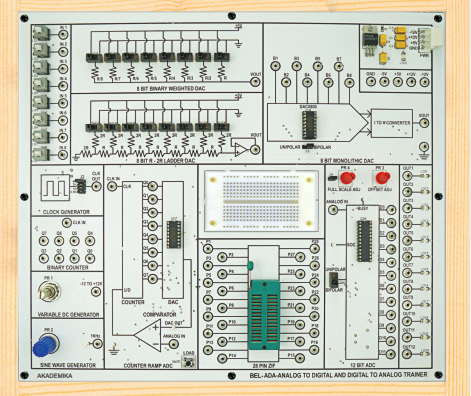
The BEL-COT Discrete Components Trainer provides a complete setup for studying the characteristics of basic semiconductor devices. Students can easily analyse VI curves, switching behaviour, and biasing methods for diodes, BJTs, LEDs, and sensor components, using a clean layout with onboard regulated power supply and measurement points. Ideal for electronics and IoT lab learning.
ABOUT THE LABORATORY
The Drone Technology Laboratory for Skill Development and Universities is a specialized facility designed by AKADEMIKA to provide hands-on training and practical experience in the field of drone technology. It serves as a dedicated space where individuals can develop the necessary skills and competencies to effectively operate, maintain, and utilize drones across various industries.
KEY FEATURES OF THE DRONE TECHNOLOGY LABORATORY:
State-of-the-art Equipment: The laboratory is equipped with cutting-edge drones, flight simulators, data acquisition tools, and software applications to provide a realistic learning environment. Students have access to a wide range of drone models, ensuring exposure to different configurations and capabilities.
Training Modules: The laboratory offers a comprehensive curriculum that covers the fundamental concepts of drones, flight operations, data analysis, and industry-specific applications
Practical Hands-on Experience: The laboratory emphasizes practical learning through hands-on exercises and simulations. Participants have the opportunity to practice drone flight operations, capture aerial media, process data, and troubleshoot technical issues.
Safety Protocols and Best Practices: Safety is a paramount concern in drone operations. The laboratory promotes the implementation of safety protocols, including pre-flight checks, airspace regulations, emergency procedures, and risk management strategies. Participants learn the importance of responsible drone use and the ethical considerations associated with drone technology.
Opportunities: Upon successful completion of the Training program, Students will enhance their employability Skills and open doors to various career opportunities in sectors such as agriculture, construction, film production, surveying, and more.
The Drone Technology Laboratory aims to bridge the gap between theoretical knowledge and practical application, equipping individuals with the expertise needed to thrive in the rapidly growing field of drone technology
CURRICULAM
Videos & Online Tutorials For DGCA drone rules and regulations / UTM / DIGISKY/ Remote Pilot Licensing / Component & Data, Identify & select different types of drones, , drone applications, and important safety precautions.
Characterization of Different Drone Parts using various Test Equipments and Software
BLDC MOTORS/ ESC/PROPELLERS: Identify, select and test hardware assembly of the propulsion system, driver for BLDC motors ( ESC ) and compatible Propeller
FLIGHT CONTROL BOARD: Test and troubleshoot Flight Controller Board (FCB), Electronic Speed Controller (ESC) and its associated peripherals
BATTERIES USED IN DRONES: Identification of different type of batteries, battery specifications and their charging techniques used in drone
SENSORS: Inspect, test and execute various IMU ,GPS navigation and telemetry module, different RF blocks and antennas used in RF transmitter and receiver
Assembly of various drone parts, Calibration and programming, troubleshooting of a Un Assembled Drone
Introduction to Flight Simulator , Control Checks, Pre Flight Check and Simulator Exercises to have an Hands – on experience before actual flight
Introduction to autonomous flight systems, Programming and configuring autonomous missions, Sensors and navigation for autonomous drones
Advanced flight techniques (obstacle avoidance, precision flying)
Drone Data Acquisition and Analysis
Drone Proto-Typing: Design Frames, Propellers etc and Manufacture using a 3 D Printer
With 35 years of legacy in Technical Education, Akademika extends its expertise to Defence and Skill development, building Innovative, Reliable Training Systems for the next generation of Learners.
Partner with Akademika
Join leading institutions that trust our engineering to Advance Learning and Research.