Technology Labs
BEL-TAT: Transistor Application Trainer
About Product
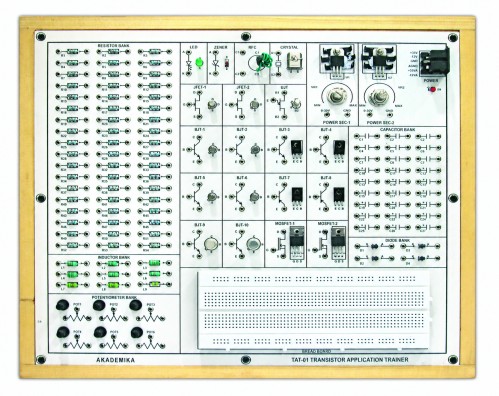
A complete board for understanding BJT, FET, MOSFET, and UJT characteristics and real circuits. Students design amplifiers, oscillators, biasing networks, feedback amplifiers, multivibrators, logic circuits, regulators, tuned circuits & sweep generators. Excellent for analog design engineering training.
- 1) Single board system, capable of covering over 20 Experiments.
2) Suitable for studying the characteristics and applications of different transistor devices.
3) IEEE symbol of all components provided on the PCB.
4) All Components are visible clearly on the top of the PCB.
5) Mobile based Interactive e-Manual.
1) On-board dual variable DC power supply of 0–30 V, suitable for circuit experimentation.
2) Resistor Bank (54 resistors)
Range from 100Ω to 1MΩ for ¼ watt
3) Capacitor Bank (27 capacitors)
Range from 47 pF to 100 µF
4) Inductor Bank (9 inductors)
Range from 2.2 mH to 47 µH
5) Potentiometer Bank (6 potentiometer)
Range from 1K to 1M
6) Light Emitting Diode (GREEN LED 5mm)
7) Diode (4 – 1N4007)
8) Zener Diode (5.1V)
9) Transistor Bank (15 transistors)
i) BC-107 : 2 nos.
ii) BD139 : 2 nos
iii) 2N2222 : 2 nos
iv) BD138 : 2 nos
v) SL100 : 2 nos
vi) BFW10 : 2 nos
vii) IRFZ44N : 2 nos
viii) 2N2646 : 1 nos
10) Breadboard (175mmX63mm)
1) To identify and check type of Transistor NPN, PNP
2) BJT as Switch
2) Logic gates using BJT
3) BJT as a DC amplifier
Amplifier
1) CE amplifier-frequency response, signal handling capacity, input and output impedance
2) Cascade amplifier-frequency response, signal handling capacity, input and output impedance
3) Single stage CB amplifier gain versus frequency
Feedback amplifier
1) Voltage series feedback (negative) amplitude, frequency response, input and output impedance calculation
2) Voltage shunt feedback (negative) amplitude, frequency response, input and output impedance calculation
3) Current series feedback (negative) amplitude, frequency response, input and output impedance calculation
4) Class-A / Class-B power amplifier
5) Fixed bias amplifier using BJT
6) Design and construct BJT common emitter amplifier using voltage divider bias (self-bias) with and without bypass emitter resistors
7) Design and construct BJT common collector amplifier using voltage divider bias (self-bias)
8) RC coupled amplifier · Emitter follower amplifier
9) Darlington amplifier · Oscillator · Multi-vibrator
Regulator
1) Series and shunt regulator, calculate ripple factor
FET / MOSFET
1) FET common source amplifiers, gain versus frequency, bandwidth, input output impedance and maximum signal handling capacity
2) Common drain FET amplifier, frequency response, signal handling capacity, input and output impedance
3) FET biasing circuit (self, voltage divider, fixed)
4) UJT relaxation oscillator / UJT saw-tooth generator
5) Construct different bias circuit and analyze the wave form a) Fixed bias b) Emitter bias c) Voltage divider bias
6) Transistor as switch with timing calculation
7) Verify digital logic gate using transistor (NOT, NAND, NOR)
8) DC amplifier
9) Transistor time delay circuit
10) Schmitt trigger circuit
11) Frequency response of single tuned coupled circuit (tuned class C)
12) Bootstrap sweep circuit
13) Sweep wave generator
With 35 years of legacy in Technical Education, Akademika extends its expertise to Defence and Skill development, building Innovative, Reliable Training Systems for the next generation of Learners.
Partner with Akademika
Join leading institutions that trust our engineering to Advance Learning and Research.