
Technology Labs
VL-ZYNQ - Zynq 7000 Series SoM with Advanced Carrier Board
SYSTEM-ON-MODULE — ZYNQ 7000
1) Powered by ARM® Dual-Core Cortex™A9 Core Processor
2) Based on Xilinx’s high-end Zynq XC7Z020 Series. All-Programmable SoC
3) Support Zynq devices XC7Z007 / 20 CLG 484 Pin package
4) 87mm x 67mm board size Compact form factor
5) Available in Production ready with industrial temperature range
6) Linux BSP, tool chain and Support available
7) Combines Flexibility of SBC with the FPGA configurability
8) Industrial Grade, Rugged platform to optimize overall BOM cost
9) On module required power supplies for efficient power management
10) Linux board support package along with Root file system enables seamless integration
11) Customized Carrier boards for instant board bring-up and quick prototyping
12) Software : Vivado + Vitis
1) Powered by ARM® Dual-Core Cortex™A9 Core Processor
2) Based on Xilinx’s high-end Zynq XC7Z020 Series. All-Programmable SoC
3) Support Zynq devices XC7Z007 / 20 CLG 484 Pin package
4) 87mm x 67mm board size Compact form factor
5) Available in Production ready with industrial temperature range
6) Linux BSP, tool chain and Support available
7) Combines Flexibility of SBC with the FPGA configurability
8) Industrial Grade, Rugged platform to optimize overall BOM cost
9) On module required power supplies for efficient power management
10) Linux board support package along with Root file system enables seamless integration
11) Customized Carrier boards for instant board bring-up and quick prototyping
12) Software : Vivado + Vitis
SYSTEM-ON-MODULE — ZYNQ 7000
Processor:
1) Dual-Core Cortex™A9 Core @ 866MHz
2) 32KB Instruction and Data L1 cache
3) Based on Xilinx’s high-end Zynq XC7Z000 Series. All-Programmable SoC
4) Support Zynq devices XC7Z007 / 20 CLG 484 Pin package
5) Enhanced NEON Extension and Single & double precision FPU
6) 512KB Unified L2 Cache
7) 256KB On-chip Memory
Memory
1) 1 GB DDR3 Support
2) 8Gb/16Gb eMMC ( Expandable )
3) Upto 128 Muit QSPI Support
FPGA
1) Xilinx Artix-7 28nm Advanced low power FPGA fabric
2) Up to 85K Logic Cells (approximately 1.3M of equivalent ASIC gates)
3) 560KB Block RAM
4) 220 programmable DSP slices (18x25MAC)
Power Supply
1) 4.5-5.5V
2) 5W (Max)
Boot Support
1) JATG / QSPI / microSD / eMMC
Ethernet - 2 Nos
1) 1 x 10/100/1000 BASE-T On module
2) 1 x 10/100/1000 BASE-T (Optional on carrier)
USB
1) 1 x USB 2.0 OTG
Display
1) Through LVDS Interface
Serial (on EMIOs)
1) 1 x UART, 2 x I2C, 2X CAN2.0
Form Factor And Board to Board Interface
1) 85 mm x 67 mm
2) 2 x 100 Pin High Speed Connectors
2) Differential and Single ended I/O
Software Support
1) Linux
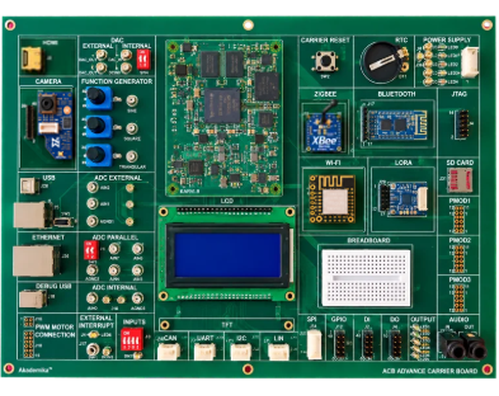
CARRIER BOARD
CARRIER - CORE, RESET & DEBUG
i) Power : Regulated supply as per SOM & peripheral load
ii) Reset : Board reset and SOM reset support
iii) RTC : External real-time-clock provision
iv) Test points : For important signals and power rails
v) SOM Interface : high-density board-to-board for SOM
CARRIER - ANALOG & SIGNAL
i) ADC : Internal & external (analog / SPI / parallel)
ii) DAC : external SPI interface DAC support
iii) Function Generator : Sine, square and Triangular waveform generation
iv) Audio : analog audio input & output
CARRIER - DIGITAL I/O & DISPLAY
i) PWM : motor driver / control output
ii) GPIO : general-purpose digital I/O
iii) User I/O : input switches & LED indication outputs
iv) Display : TFT / GLCD
v) PMOD : PMOD-compatible expansion connectors
CARRIER - COMMUNICATION & WIRELESS INTERFACES
i) SPI : serial communication interface
ii) I2C : serial communication interface
iii) UART : serial communication interface
iv) CAN : industrial communication interface
v) LIN : automotive communication interface
vi) Bluetooth : external module interface
vii) ZigBee : external module interface
viii) Wi-Fi : external module interface
ix) LoRa : external module interface
CARRIER - MULTIMEDIA & CONNECTIVITY
i) Camera : DCMI camera interface (STM32 DCMI or equivalent)
ii) HDMI / Display : HDMI or display conversion interface
iii) USB : USB Host and USB Device interfaces
iv) Ethernet : for networking applicationsmicro
v) SD : SDIO / SPI card interface
SOFTWARE
AMD Vivado Design Suite and the AMD Vitis Software
1) AMD Vivado
i) Hardware-centric design
ii) Core tasks: Handles design entry (writing Verilog, VHDL, or block diagrams)
iii) Output: Generates the hardware bitstream file
2) AMD Vitis
i) Software-centric design
ii) Used for writing the software that runs on the processors (like Arm cores) inside your SoC or managing high-level synthesis.
Processor:
1) Dual-Core Cortex™A9 Core @ 866MHz
2) 32KB Instruction and Data L1 cache
3) Based on Xilinx’s high-end Zynq XC7Z000 Series. All-Programmable SoC
4) Support Zynq devices XC7Z007 / 20 CLG 484 Pin package
5) Enhanced NEON Extension and Single & double precision FPU
6) 512KB Unified L2 Cache
7) 256KB On-chip Memory
Memory
1) 1 GB DDR3 Support
2) 8Gb/16Gb eMMC ( Expandable )
3) Upto 128 Muit QSPI Support
FPGA
1) Xilinx Artix-7 28nm Advanced low power FPGA fabric
2) Up to 85K Logic Cells (approximately 1.3M of equivalent ASIC gates)
3) 560KB Block RAM
4) 220 programmable DSP slices (18x25MAC)
Power Supply
1) 4.5-5.5V
2) 5W (Max)
Boot Support
1) JATG / QSPI / microSD / eMMC
Ethernet - 2 Nos
1) 1 x 10/100/1000 BASE-T On module
2) 1 x 10/100/1000 BASE-T (Optional on carrier)
USB
1) 1 x USB 2.0 OTG
Display
1) Through LVDS Interface
Serial (on EMIOs)
1) 1 x UART, 2 x I2C, 2X CAN2.0
Form Factor And Board to Board Interface
1) 85 mm x 67 mm
2) 2 x 100 Pin High Speed Connectors
2) Differential and Single ended I/O
Software Support
1) Linux
CARRIER BOARD
CARRIER - CORE, RESET & DEBUG
i) Power : Regulated supply as per SOM & peripheral load
ii) Reset : Board reset and SOM reset support
iii) RTC : External real-time-clock provision
iv) Test points : For important signals and power rails
v) SOM Interface : high-density board-to-board for SOM
CARRIER - ANALOG & SIGNAL
i) ADC : Internal & external (analog / SPI / parallel)
ii) DAC : external SPI interface DAC support
iii) Function Generator : Sine, square and Triangular waveform generation
iv) Audio : analog audio input & output
CARRIER - DIGITAL I/O & DISPLAY
i) PWM : motor driver / control output
ii) GPIO : general-purpose digital I/O
iii) User I/O : input switches & LED indication outputs
iv) Display : TFT / GLCD
v) PMOD : PMOD-compatible expansion connectors
CARRIER - COMMUNICATION & WIRELESS INTERFACES
i) SPI : serial communication interface
ii) I2C : serial communication interface
iii) UART : serial communication interface
iv) CAN : industrial communication interface
v) LIN : automotive communication interface
vi) Bluetooth : external module interface
vii) ZigBee : external module interface
viii) Wi-Fi : external module interface
ix) LoRa : external module interface
CARRIER - MULTIMEDIA & CONNECTIVITY
i) Camera : DCMI camera interface (STM32 DCMI or equivalent)
ii) HDMI / Display : HDMI or display conversion interface
iii) USB : USB Host and USB Device interfaces
iv) Ethernet : for networking applicationsmicro
v) SD : SDIO / SPI card interface
SOFTWARE
AMD Vivado Design Suite and the AMD Vitis Software
1) AMD Vivado
i) Hardware-centric design
ii) Core tasks: Handles design entry (writing Verilog, VHDL, or block diagrams)
iii) Output: Generates the hardware bitstream file
2) AMD Vitis
i) Software-centric design
ii) Used for writing the software that runs on the processors (like Arm cores) inside your SoC or managing high-level synthesis.
1) AMBA Bus Design
i) AXI4-Lite to Memory
ii) AXI-GPIO with Switch/LED
iii) APB Timer
iv) AXI DMA Controller
v) AXI Burst Verification
2) Core DSP
i) FFT
ii) FIR Filter
iii) IIR Filter
iv) Convolution and Correlation
v) Real-Time Audio Equalizer
3) Image Processing
i) Greyscale Conversion
ii) Edge Detection (Sobel)
iii) Smoothing / Gaussian Blur
iv) VGA Display of Processed Image
4) SoC Design
i) Hello World on Soft-Core Processor
ii) GPIO LED Control
iii) UART Communication
iv) SPI / I2C Peripheral
5) RISC Architecture
i) Single-Cycle RISC CPU
ii) ALU Design
iii) Register File
iv) Instruction Fetch Unit
v) 5-Stage Pipelined Processor
6) Communication Systems
i) PN Sequence Generator
ii) DSSS
iii) CDMA
iv) Modulation (BPSK / QPSK / FSK)
i) AXI4-Lite to Memory
ii) AXI-GPIO with Switch/LED
iii) APB Timer
iv) AXI DMA Controller
v) AXI Burst Verification
2) Core DSP
i) FFT
ii) FIR Filter
iii) IIR Filter
iv) Convolution and Correlation
v) Real-Time Audio Equalizer
3) Image Processing
i) Greyscale Conversion
ii) Edge Detection (Sobel)
iii) Smoothing / Gaussian Blur
iv) VGA Display of Processed Image
4) SoC Design
i) Hello World on Soft-Core Processor
ii) GPIO LED Control
iii) UART Communication
iv) SPI / I2C Peripheral
5) RISC Architecture
i) Single-Cycle RISC CPU
ii) ALU Design
iii) Register File
iv) Instruction Fetch Unit
v) 5-Stage Pipelined Processor
6) Communication Systems
i) PN Sequence Generator
ii) DSSS
iii) CDMA
iv) Modulation (BPSK / QPSK / FSK)
With 35 years of legacy in Technical Education, Akademika extends its expertise to Defence and Skill development, building Innovative, Reliable Training Systems for the next generation of Learners.
Partner with Akademika
Join leading institutions that trust our engineering to Advance Learning and Research.