Technology Labs
WB-FTTH: Fiber To The Home Network Workbench
About Product
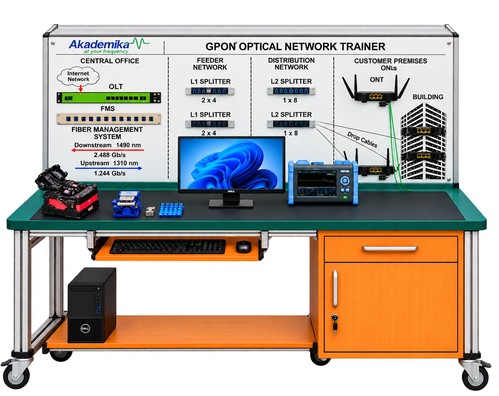
The Fiber to the Home Network Workbench is a comprehensive training platform designed for hands-on learning of GPON and FTTH network design, installation, configuration, and maintenance. It includes OLT, ONT/ONU, optical splitters, fiber management systems, OTDR, and fusion splicing equipment. The workbench enables practical experiments in optical network configuration, fiber splicing, fault detection, and network performance testing.
1) Hands-on platform for GPON, FTTH, FTTP and FTTR network design, deployment, commissioning, configuration and maintenance.
2) Provision to work with OLTs, ONUs/ONTs, optical splitters, feeder/distribution/drop fibers and FTTH termination hardware.
3) Power supply sockets for 5 and 15 Amps and Circuit breaker for Protection
4) Smooth surface and antistatic pad
5) Movable caster wheel
6) Required fiber network equipements
7) Aluminium extrusion Frame
i) i) Dimensions : 1500mm x 750mm x 750mm
ii) 25mm Table Top
iii) 30mm × 30mm aluminium extrusion
iv) Lockable castor wheels
v) Cupboard with shelf : 450mm x 450mm x 450mm
vi) Drawer : 450mm x 450mm x 150 mm
vii) Computer Keyboard drawer under the table 50mm x 380mm
viii) Electric Panel height from table top 100mm
ix) 5 Sockets with circuit breaker
x) Back panel 900mm above the table top
xi) Perforated sheet panel for hanging tools 600mm
xii) Baseplate for Computer 1000mm x 375mm
Optical Network Configuration and Management System
A) Hardware Specification
i) Minimum 8 Gigabit ports
ii) Minimum 4 PON ports provided with 4 SFP.
iii) Wavelength: Tx 1490 nm, Rx 1310 nm.
iv) Transmission distance: 20 km.
v) Voice, Data and IPTV support.
B) Management Software Specification
i) Support for IPv4 and IPv6 networks.
ii) Port-status monitoring and configuration management including VLAN, Trunk, RSTP, IGMP and QoS.
iii) Support for data encryption, multicast and port VLAN.
iv) Online Network Unit configuration and management.
v) Management functions including DBA, Network Unit authorization, ACL and QoS.
vi) Support for Static and Dynamic Bandwidth Allocation.
vii) Support for port-based QinQ and Selective QinQ (Stack VLAN).
viii) Support for port-based, MAC-based and IP-subnet-based VLAN.
ix) Remote ONT configuration for Internet and voice.
x) Support for HTTP enable/disable from OLT.
xi) Built-in DHCP server.
xii) Advanced Encryption Standard (AES) for securing downstream traffic.
xiii) AC/DC voltage protection against short circuit and overload, with grounding point.
xiv) Fully compliant with ITU GPON standards.
C) Optical Network Components
i) Single Mode G.652, 9/125, 6-core feeder cables.
ii) Single Mode G.652, 9/125, 6-core distribution cables.
iii) Single Mode G.657 drop cables.
iv) PLC optical splitters, Fiber Distribution Box.
v) Fiber management system, Joint enclosures.
vi) FTTH boxes, Fiber optic termination boxes.
vii) Optical patch cords, Optical pigtails.
viii) 0 dB adaptors, Dual-band Optical Network Units.
Optical Tools and Measuring Instruments
1. Optical Time Domain Reflectometer (OTDR)
i) Wavelength (nm): 1310 ±20, 1550 ±20
ii) Applicable fiber: SM (ITU-T G.652)
iii)Distance range (km): 0.2, 0.5, 1, 2, 5, 10, 20, 30, 50, 100, 200, 256
iv) Pulse width (ns): 3, 10, 20, 30, 50, 100, 200, 300, 500, 1000, 2000, 5000, 10000, 20000
v) Sampling resolution: min. 5 cm
vi) Number of sample points: max. 256000
vii) Event dead zone (m)*¹: ≤ 0.8
viii) Distance measurement accuracy (m): ±(1 m + Measurement distance × 2 × 10⁻⁵ ±1 sampling resolution)
ix) Attenuation dead zone (m)*², *⁴: 4/5
x) Dynamic range (dB)*³, *⁴: 32/30
xi) Loss measurement accuracy: ±0.03 dB/dB
xii) Reflection accuracy: ±2 dB
xiii) Laser class: Class 1M
xiv) Display*: 5.0 inch color TFT LCD WVGA (Capacitive touchscreen)
xv) Resolution: 800 × 480 pixel
xvi) External interfaces: USB2.0 × 2; Type A × 1: Host, Type micro B × 1: USB mass storage devices power supply
xvii) Wireless LAN (WLN option): IEEE802.11b/g/n
xviii) Battery Type: Lithium ion polymer
2. Event Module
i) The OTDR should be supplied with a Fiber Optic Event Module which should be mounted on a Sturdy Aluminum Casing emulating various Fiber Events. All the the events should be terminated with SC Adaptors. Various Events Like Splice , Attenuator , Splitter and Single Mode Fiber of Different Lengths should be housed in the Module.
3. Fusion Splicing Machine
i) Fiber alignment: Core/cladding alignment / manual alignment.
ii) Splicing time: 9 sec; heating time: 22 sec.
iii) Applicable fibers: SM (G.652/G.657), MM (G.651), DS (G.653), NZDS (G.655), EDF and BIF/UBIF.
iv) Cladding diameter: 90–150 µm.
v) Coating diameter: 125–1000 µm
vi) Return loss: Better than 60 dB.
vii) Splice loss: 0.02 dB (SM), 0.01 dB (MM), 0.04 dB (DS), 0.04 dB (NZDS).
Connectorization Tool Kit
i) ST fiber polishing disc : 01 No.
ii) Fiber polishing sheets : 10 No.
iii) Fiber polishing pad : 01 No.
iv) Fiber optic zoom microscope : 01 No.
v) Jacket stripper : 01 No.
vi) Buffer stripper : 01 No.
vii) Fast connector : 10 No.
viii) Optical fiber Spool : 100mtr.
ix) Optical multi-meter : 01 No.
FTTH Tool Kit
i) Power Meter
ii) FC-6S Fiber Cleaver
iii) Dual-hole Fiber Optic Stripper
iv) Fiber Optic Stripper
v) 5mW Visual Fault Locator
vi) Empty bottle, Fixator
vii) AA Battery
viii) Bag for Visual Fault Locator
ix) Bag for Fiber Cleaver
x) Hexagon Wrench
xi) Adapter for Power Meter
xii) Storage Bag for all Tools
*Image shown is for reference only and does not represent the actual workbench configuration or design.
1) Study and Identification of various sections of the GPON FTTH Network.
2) Identification of various Networking devices used in the Optical communication PON network
- OLT, Optical FMS , FDB, Splitter, and ONT /ONU.
3) Test the signal flow path of a FTTH Network.
4) Insertion Loss Testing and Performance Evaluation of Optical Splitters.
5) Installation of Fiber Distributor Box (FDB).
6) Installation and Study of Optical Distribution Network.
7) Deployment and Configuration of OLT and ONU in a Fiber-to-the-Home (FTTH) Network
- Accessing Web Management Interface
- Viewing Network Device Mac Addresses
- Accessing OLT Remotely
- Building A Basic OLT And ONU Configuration
8) Perform OTDR test and find the faults in the link using the Fiber Event Module.
9) Measure cable performance using OTDR.
10) Demonstrate fiber preparation for splicing (strip jacket, dressing buffer tubes & fibers, strength members, removal of buffer coating).
11) Demonstrate fusion splicing and measure splice loss.
With 35 years of legacy in Technical Education, Akademika extends its expertise to Defence and Skill development, building Innovative, Reliable Training Systems for the next generation of Learners.
Partner with Akademika
Join leading institutions that trust our engineering to Advance Learning and Research.